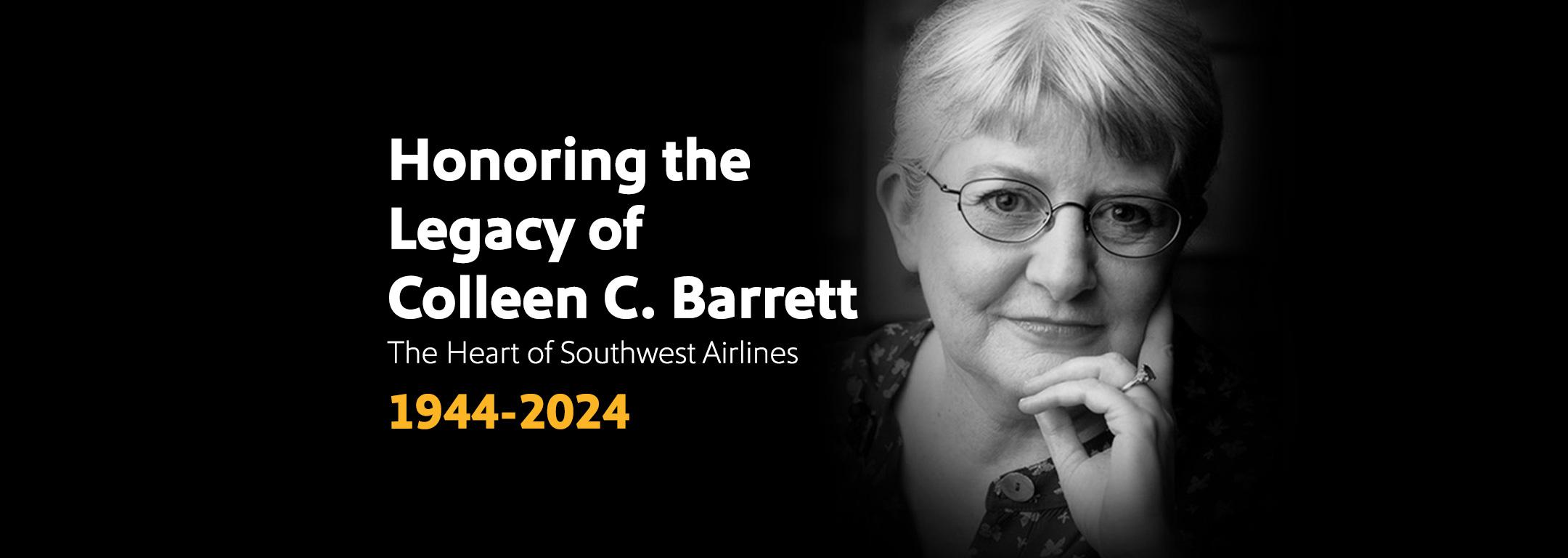
Happy Birthday to Colleen C. Barrett, founder of the Institute for Cultural Excellence & Customer Service

balloons
Southwest online rgb rev

Happy Birthday to Colleen C. Barrett, founder of the Institute for Cultural Excellence & Customer Service

Southwest online rgb rev

The Colleen C. Barrett Institute for Cultural Excellence & Customer Service

Southwest online rgb rev
3 8 TL

Organizational Identity: Company and Employee Promises

As I think about promises and what they mean to me, I’m taken back to my time in the Army. In the military, a promise is a sacred bond that we honor with our lives. It’s a commitment to serve, protect, and defend, no matter the cost. And I carry that thinking with me every day.

When we make a promise, we are creating a bond of trust with those around us. We are saying that we are going to do what we say we are going to do, that we are reliable and dependable, and that we value the people to whom we are making the promise. Promises can also offer a beacon of hope—a guiding light that can help us navigate through the ups and downs of life.

That has never been truer than when we faced one of the toughest challenges in our history during the operational disruption this past December, when we couldn’t live up to the promises we made to our Customers or to our Employees.

As a Company, we promise to provide our Customers with affordable fares and one-of-a-kind Southwest Hospitality, while giving our Employees a stable work environment grounded in kindness, respect, and compassion. As a Leader, I take that as a personal mission, to make sure we’re holding up our end of the bargain and delivering on our commitments.

Inevitably, there will be times when promises are hard to keep, when goals and relationships are tested. But in those moments, if we keep working to honor our word and make things right after a promise is broken, many times we can foster greater trust and build even stronger relationships.

Our Company and Employee Promises will always be our North Star—helping us learn from and move past what happened in December, continually improve our operation, take better care of our People, and strengthen our brand. And they will continue to drive us as they have for more than 51 years.

For me, I will never stop pushing myself to deliver on my own promises as well as our Company’s. Each day, I ask myself—and I encourage you to ask yourself—am I keeping my promises? Am I living up to the oaths I’ve made? How can I contribute, alongside all of our Employees, to strengthen our Culture of trust, loyalty, and accountability?

XOXO,
Picture of Andrew Watterson

Andrew Watterson

Chief Operating Officer

View Thought Leaders Recommended Resources

Have a question? We'd love to hear from you!

Submit your questions below and our Thought Leaders might address them in future articles and newsletters!

12 8 22 TL
Eric Campbell

Healthy Teams: Leading Teams That Are Both Driven and Kind

In the airline industry, Customers travel for a broad spectrum of reasons, and when experiences do not go as planned, emotions can run high. In those moments, frontline Employees represent both the first and last opportunity to ensure Customers feel welcomed, cared for, and appreciated. As Leaders, our responsibility is to support Teams in navigating these interactions with clarity, consistency, and the right mindset.

Over time, I’ve come back to two guiding principles that help anchor that mindset, both of which align closely with how we lead at Southwest.

First, don’t take things personally. When Customer emotions are elevated, a natural reaction is to put up a defense—deflecting blame, trying to find a silver lining, or in a worst-case scenario, matching the negative energy with a poor attitude. While we can’t always control what happened, we can control how we respond.

Read More
newsletter hero sept 24
Carrie Mills

Healthy Teams: Leading High-Trust High-Performing Teams

In my nine-year career at Southwest, I have been fortunate to be supported and led by individuals who modeled integrity and did so with resolute consistency. That kind of leadership not only instills trust but teaches you how to lead others with that same commitment, which is crucial for navigating work that presents challenges that may not always have a clear or obvious solution.

Healthy teams are built through leadership behaviors that create both trust and healthy conflict. These elements may seem to work against each other; however, they must coexist. The strongest teams are those where individuals feel safe to speak up, challenge ideas, and admit mistakes. They also hold themselves and one another to a high standard of performance and ownership.

Read More
oct22 newsletter
Patrick Lencioni

Healthy Teams: From Dysfunction to Cohesion to Strength

Like it or not, all teams are potentially dysfunctional. From the basketball court to the executive suite, politics and confusion are more the rule than the exception. Why? Because teams are made of imperfect, fallible human beings. At the same time, and in beautiful irony, being exceedingly human is also why teams succeed.

A former and quite successful client best expressed the power of teamwork when he once told me, “If you could get all the people in the organization rowing in the same direction, you could dominate any industry, in any market, against any competition, at any time.” When I repeat this to leaders, they immediately nod their heads but in a desperate sort of way. They grasp the truth while simultaneously surrendering to the perceived impossibility of it. Fortunately, there is hope!

Read More
Scroll to Top