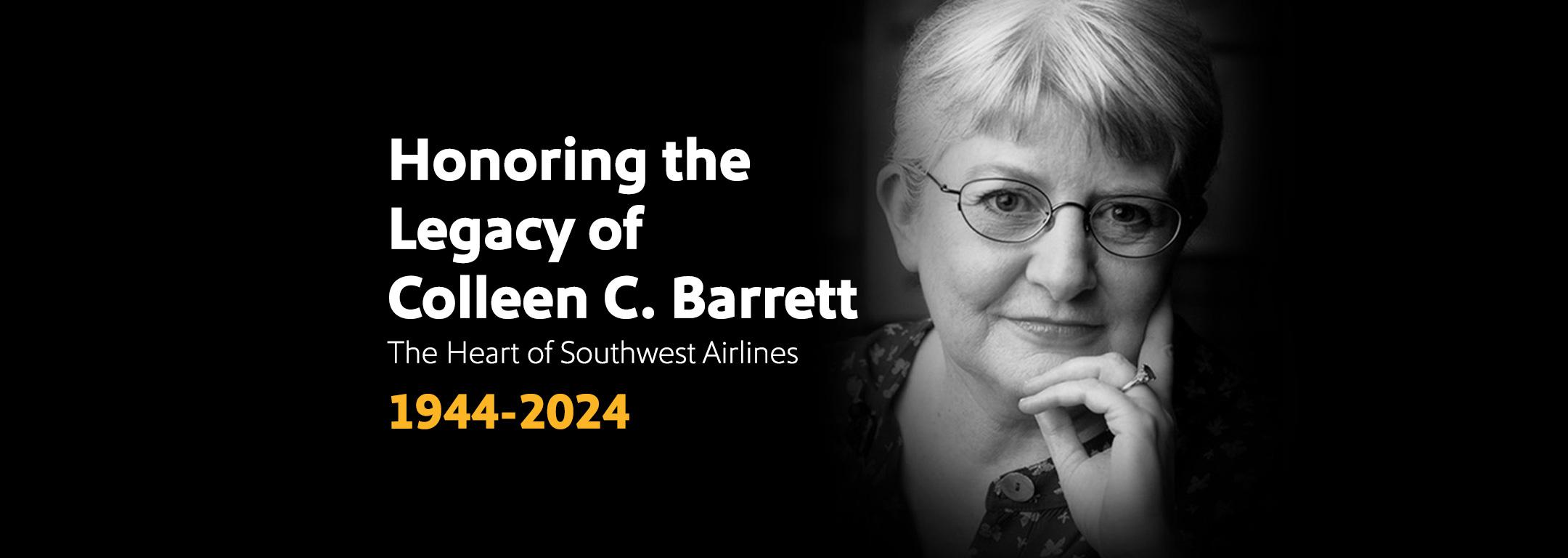
Colleen’s “Food For Thought” column originally appeared in the April 1996 edition of Southwest Airlines’ internal magazine LUVLines.
Have you ever wondered why Southwest Airlines receives such an incredible amount of media coverage? Obviously, we have a wonderful Public Relations Department making sure our accomplishments and activities don’t go unnoticed, but the mere fact that we are a “successful airline”—two words most people think don’t go together—makes us newsworthy. It also leaves us—and everything we do—open to scrutiny.
And, while we openly embrace the pressure of achieving consistent performance, we also accept a tremendous amount of responsibility to sustain and surpass our previous successes. For 25 years, Southwest Airlines has turned in a praiseworthy, if not spunky, performance. After our third year of operation—the first in which we made money—we tacitly accepted the challenge to remain profitable and have met this challenge in each subsequent year. Despite the repeated and sometimes spiteful will of our competitors to break our stride and cripple our spirit, we have continued to grow and prosper and to care for one another as families do.
It’s hard, then, to imagine suddenly not having the security, pride, stability, and comfort many of us derive from being a productive part of Southwest Airlines. And it’s difficult to imagine not being able to overcome a particular challenge or having to admit defeat at the hands of a competitor. To many of us, these are unthinkable—impossible—improbable things that simply will not happen.
More than likely, this is also how the employees of Rubbermaid, Inc. felt in the 1980s when their company was the “darling” of Wall Street and seemingly invincible with strong annual growth, high consumer recognition, and quality products. (Any of this sound familiar?) In 1993 and 1994, Rubbermaid was named America’s most admired corporation by Fortune magazine-further strengthening the confidence of its employees and management.
Why, then, did I recently read a Wall Street Journal article lamenting Rubbermaid’s plans to cut nine percent of its workforce and consolidate its manufacturing plants by shutting down nine facilities in an attempt to make distribution more efficient? It apparently took only a matter of months to go from award-winning to crisis-bound, almost as if no warning had been given. It seems too much confidence had been invested in what Rubbermaid had accomplished, and not enough time was spent “minding the store.
According to the article, the company was “beset by high-raw material costs, prickly relationships with retailers, and reduced demand for its widely recognized and respected products.” Rubbermaid focused on short term gains at the expense of long term planning and was effectively blindsided by changes in the economy and the retail market. This, coupled with a disenchanted workforce and significant turnover, forced the company to “inject themselves with a dose of reality” and take the painful first step to regaining precious lost ground. Unfortunately, this step was at the expense of their employees.
As I read the article, I couldn’t help thinking how closely Rubbermaid’s challenges parallel our own–high fuel costs, disgruntled Customers, and increased competition from low-cost, clone carriers. It has been said that Southwest Airlines has “ridden a wave of success” for many years, and this, in a sense, is very true. The question is, “How long can we ride it without losing our balance?” And the answer, not surprisingly, lies with you and me.
If we assume we will not fail, chances are we will fail quickly. If we allow our past successes to excuse any present shortcomings, we will soon have no more successes. And if our focus shifts from “we” to “me,” or, even worse, to “they,” there will be no more “us.” The most frightening thing about each of these principles, to me at least, is how quickly they can weaken and destroy a seemingly vibrant company. Rubbermaid is but one example there are countless more within our own industry. And, as unkind as it may be, there are people-companies with different philosophies and goals–who genuinely want (and are waiting for) Southwest Airlines to fail.
No, this is not “another one of those complacency talks,” and it isn’t intended to cast a shadow on our accomplishments or on the good feelings many of us cherish from belonging to one of the most respected companies in America. This is real life. It happens every day, and we can never allow ourselves to think for a moment that we have it made. This is our Company, our family, our investment, and our future, and we as a people are the only ones willing and able to protect, preserve, and perpetuate these interests.
I mention these things not to create fear or foster discouragement. Indeed, you are not strangers to the challenges we face—even those less obvious. I say them only to offer a gentle reminder of what lies before us now and ahead of us in the future. Fortunately for us, unlike many other groups, we can take comfort knowing that our hopes are collectively cared for by the most dedicated, motivated, conscientious group of Employees ever assembled.
I freely and wholeheartedly support you, and I genuinely appreciate your dedication and commitment to Southwest Airlines.
At the time of publication, Colleen was Executive Vice President—Customers.