


Happy Birthday to Colleen C. Barrett, founder of the Institute for Cultural Excellence & Customer Service

balloons
Southwest online rgb rev

Happy Birthday to Colleen C. Barrett, founder of the Institute for Cultural Excellence & Customer Service

Southwest online rgb rev

The Colleen C. Barrett Institute for Cultural Excellence & Customer Service

Southwest online rgb rev
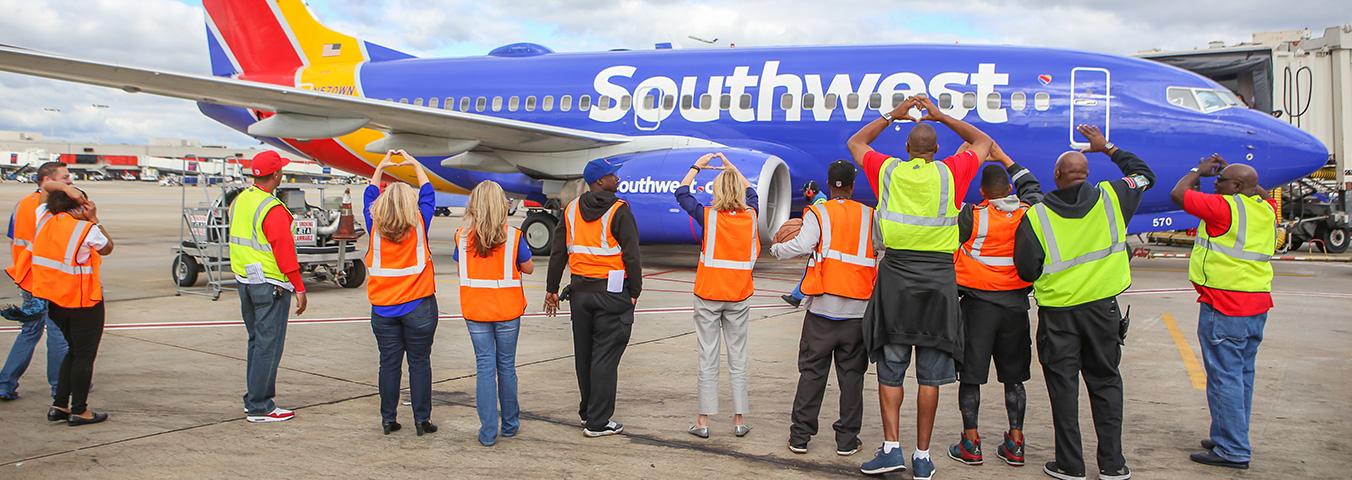
employees airplane hearts

Being Well: Incorporating Wellness into Corporate Culture

Life can throw us all kinds of curve balls, and I’ve personally had times when I’ve needed a little extra help—whether grieving the loss of someone close to me or dealing with my pesky knees that tend to have so much trouble! Southwest has been there every step of the way as I’ve been shown tremendous care by my Cohearts and provided with incredible benefits that help with my wellbeing. At Southwest, our Culture of caring is real. Our President Emeritus Colleen Barrett (namesake of the CCB Institute!) was devoted to taking care of our People from the very beginning, and that has not changed in over 52 years. We want our People to live and work well—both at work and home!

Because we know that wellbeing involves every aspect of life, today we focus on six dimensions of wellbeing (based on Gallup research): physical, mental, financial, career, social, and community. We seek to understand through Employee feedback and data what we are doing well and what pain points we can work to improve through projects sponsored by our cross-functional Wellbeing Executive Steering Group. 

In addition to our robust “core” Total Rewards package of financial compensation, retirement programs, health and insurance benefits, travel privileges, and other perks, we offer numerous wellbeing-focused programs and resources, for example:

  • Clear Skies, our Employee Assistance Program (EAP), provides mental health services to help Employees and their family members.
  • Dedicated onsite (and via phone) resources to address EAP questions, health needs, and Retirement Plan strategies.
  • Discounts for gym memberships and wellness and nutrition programs.

And it doesn’t stop there. Constantly assessing Employee needs, we introduced several new wellbeing offerings over the last year, including support for hypertension, expanded fertility benefits, additional support for orthopedic surgical procedures and treatment, supplemental hospital plan enhancements, and enhanced medical and vision plan features.

We also recognize that our Leaders play a critical role in supporting the wellbeing of our Employees—the key word being “support.” Leaders are not expected to be therapists, financial advisors, etc., so we introduced training in 2023 to help them navigate that responsibility. Mental health is a delicate topic, and we want to equip and encourage Leaders to foster an environment of trust where Employees feel they can share when they are struggling. That kind of transparency helps Leaders connect Employees with valuable resources in a supportive and appropriate way.

The health and strength of our Company is directly related to the health and wellbeing of our Employees. It really is that simple!

Picture of Lori Winters

Lori Winters

Former VP Total Rewards

View Thought Leaders Recommended Resources

Have a question? We'd love to hear from you!

Submit your questions below and our Thought Leaders might address them in future articles and newsletters!

12 8 22 TL
Eric Campbell

Healthy Teams: Leading Teams That Are Both Driven and Kind

In the airline industry, Customers travel for a broad spectrum of reasons, and when experiences do not go as planned, emotions can run high. In those moments, frontline Employees represent both the first and last opportunity to ensure Customers feel welcomed, cared for, and appreciated. As Leaders, our responsibility is to support Teams in navigating these interactions with clarity, consistency, and the right mindset.

Over time, I’ve come back to two guiding principles that help anchor that mindset, both of which align closely with how we lead at Southwest.

First, don’t take things personally. When Customer emotions are elevated, a natural reaction is to put up a defense—deflecting blame, trying to find a silver lining, or in a worst-case scenario, matching the negative energy with a poor attitude. While we can’t always control what happened, we can control how we respond.

Read More
newsletter hero sept 24
Carrie Mills

Healthy Teams: Leading High-Trust High-Performing Teams

In my nine-year career at Southwest, I have been fortunate to be supported and led by individuals who modeled integrity and did so with resolute consistency. That kind of leadership not only instills trust but teaches you how to lead others with that same commitment, which is crucial for navigating work that presents challenges that may not always have a clear or obvious solution.

Healthy teams are built through leadership behaviors that create both trust and healthy conflict. These elements may seem to work against each other; however, they must coexist. The strongest teams are those where individuals feel safe to speak up, challenge ideas, and admit mistakes. They also hold themselves and one another to a high standard of performance and ownership.

Read More
oct22 newsletter
Patrick Lencioni

Healthy Teams: From Dysfunction to Cohesion to Strength

Like it or not, all teams are potentially dysfunctional. From the basketball court to the executive suite, politics and confusion are more the rule than the exception. Why? Because teams are made of imperfect, fallible human beings. At the same time, and in beautiful irony, being exceedingly human is also why teams succeed.

A former and quite successful client best expressed the power of teamwork when he once told me, “If you could get all the people in the organization rowing in the same direction, you could dominate any industry, in any market, against any competition, at any time.” When I repeat this to leaders, they immediately nod their heads but in a desperate sort of way. They grasp the truth while simultaneously surrendering to the perceived impossibility of it. Fortunately, there is hope!

Read More
Scroll to Top