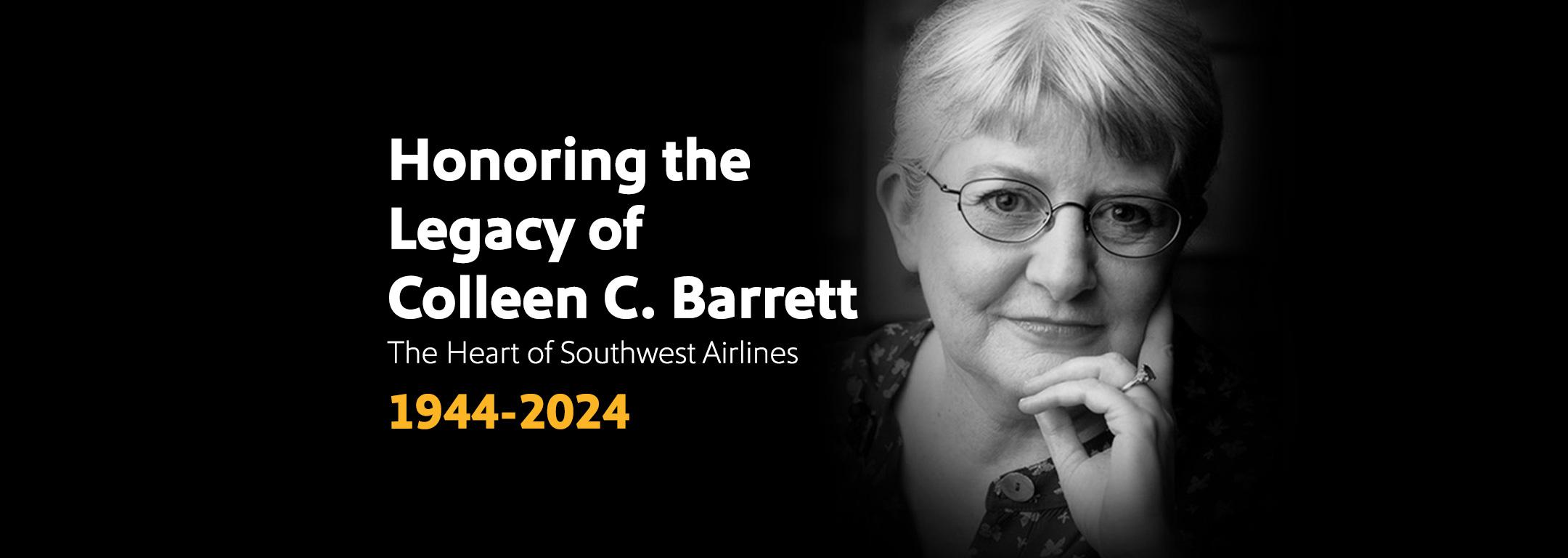

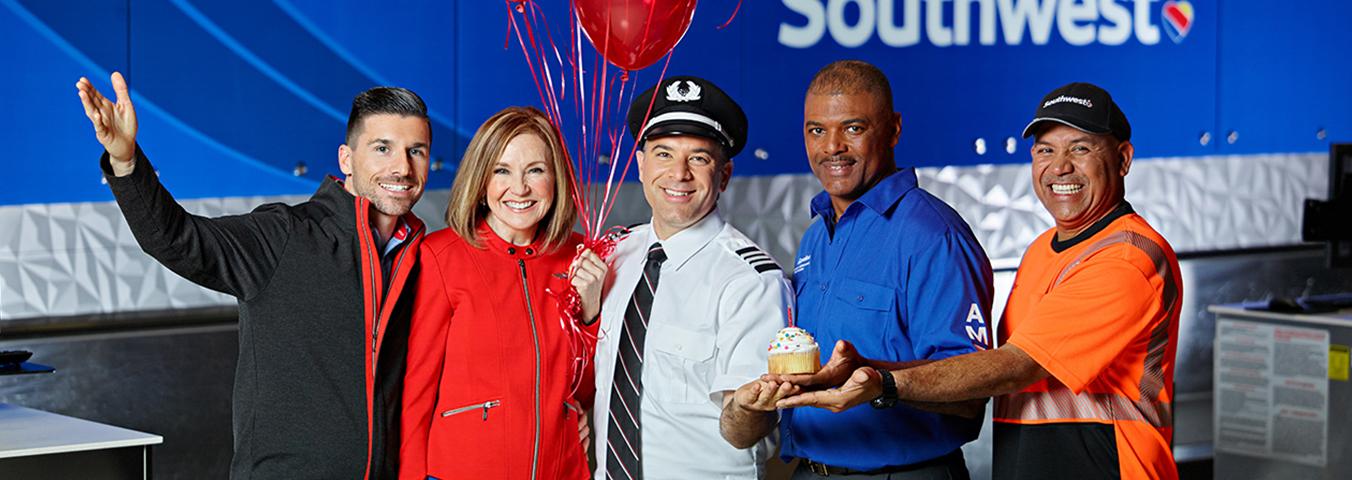


Happy Birthday to Colleen C. Barrett, founder of the Institute for Cultural Excellence & Customer Service

balloons
Southwest online rgb rev

Happy Birthday to Colleen C. Barrett, founder of the Institute for Cultural Excellence & Customer Service

Southwest online rgb rev

The Colleen C. Barrett Institute for Cultural Excellence & Customer Service

Southwest online rgb rev
12 8 22 TL

Recognition: Top-down Recognition

At Southwest, we talk a lot about putting our People first. It’s our Employees who make us an industry leader. Recognizing and appreciating them is not only the right thing to do, data shows that it has an undeniable positive impact on Employee engagement. It’s also true that engaged Employees tend to work more safely and productively. And in the airline industry—particularly the area of Technical Operations, which encompasses the highly-regulated and safety-sensitive work of aircraft maintenance—safety and productivity are paramount. There is no room for compromise in these areas, which makes it all the more important for our Leaders to be genuinely invested in cultivating an engaged workforce. For these reasons, we intentionally appreciate and recognize our Employees through several formal programs and countless informal ways.

Southwest offers an online recognition platform that our Leaders can use daily, monthly, quarterly, and annually to recognize their Team Members. Leaders also have the flexibility and authority to do what is right for their People. Something we emphasize in Tech Ops is taking a personal approach to recognizing important life events. Our Leaders are great about sending hand-written notes to acknowledge weddings, deaths in the family, new babies, or any number of moments that matter to our Employees. This is one of my favorite things to do each week. It always makes me feel so connected to our Team. 

However, recognition takes effort. I’d be lying if I told you we don’t have to work on it. We do! The daily demands on our Leaders are extensive, and recognition could easily fall through the cracks when trying to manage over 4,000 flights a day. Within our department, we set recognition goals for each Leadership Team to ensure that our Leaders are integrating an appropriate amount of recognition for our Employees throughout the year. We also include our recognition performance metrics in our quarterly business review. This helps ensure that we, as Leaders, hold each other accountable for valuing the recognition of our Employees as highly as we value our operational and financial performance. And it’s paying off! Our Employee Engagement and survey results are trending positively.

For us, spending time and effort recognizing our People is not only good for business, it’s good for the heart! 

XOXO,

Picture of Landon Nitschke

Landon Nitschke

Senior Vice President Technical Operations

View Thought Leaders Recommended Resources

Have a question? We'd love to hear from you!

Submit your questions below and our Thought Leaders might address them in future articles and newsletters!

9 8 22 TL
Patrick Lencioni

Healthy Cultures: The Crucial Caretaking of Talent

The “war” for talent is real. Across all industries, companies must compete for people with the right skills and attitude that all great organizations need to grow and sustain success. Without the right “weapons,” it’s a hard battle to win.

Conventional wisdom says the key to winning talent is to be aggressive about salaries, bonuses, stock options, and perks. No reasonable person would disagree that financial reward plays a tremendous role in an employee’s decision to stay in a job. But it’s not the most important variable—not even close.

Engaged, loyal employees are cultivated by a healthy organizational culture—one that invites participation, is free from needless politics, and offers pathways to grow both professionally and personally. For organizations that don’t prioritize their foundational culture or address cultural dysfunction, any other attempt to retain and attract people will effectively be the equivalent of reshuffling deck chairs on the Titanic.

Read More
12 8 22 TL
Eric Campbell

Healthy Teams: Leading Teams That Are Both Driven and Kind

In the airline industry, Customers travel for a broad spectrum of reasons, and when experiences do not go as planned, emotions can run high. In those moments, frontline Employees represent both the first and last opportunity to ensure Customers feel welcomed, cared for, and appreciated. As Leaders, our responsibility is to support Teams in navigating these interactions with clarity, consistency, and the right mindset.

Over time, I’ve come back to two guiding principles that help anchor that mindset, both of which align closely with how we lead at Southwest.

First, don’t take things personally. When Customer emotions are elevated, a natural reaction is to put up a defense—deflecting blame, trying to find a silver lining, or in a worst-case scenario, matching the negative energy with a poor attitude. While we can’t always control what happened, we can control how we respond.

Read More
newsletter hero sept 24
Carrie Mills

Healthy Teams: Leading High-Trust High-Performing Teams

In my nine-year career at Southwest, I have been fortunate to be supported and led by individuals who modeled integrity and did so with resolute consistency. That kind of leadership not only instills trust but teaches you how to lead others with that same commitment, which is crucial for navigating work that presents challenges that may not always have a clear or obvious solution.

Healthy teams are built through leadership behaviors that create both trust and healthy conflict. These elements may seem to work against each other; however, they must coexist. The strongest teams are those where individuals feel safe to speak up, challenge ideas, and admit mistakes. They also hold themselves and one another to a high standard of performance and ownership.

Read More
Scroll to Top